





Between the ages of 30 and 40, women start considering a facelift. To understand which lifting method is most effective and how to choose the right anti-aging procedures, we consulted with plastic surgeon Valentyn Zykov, who professionally helped us understand this issue.
What determines the degree of a facelift?
The degree of a facelift heavily depends on tissue mobility and fullness. Ideal candidates for a facelift are thin patients with light and highly mobile tissues. The skin of a person with such constitution and parameters can be stretched significantly, achieving a long-lasting result. In combination with lipofilling, it will be even better.
The denser the tissues and the “heavier” the face, the less pronounced the result, i.e., the degree of the facelift will be smaller or will be lost faster. It should be understood that the skin can double in its area depending on the tension, and no miracles should be expected. In the case of heavy facial tissues, it is necessary to stretch the SMAS layer (superficial musculoaponeurotic system) as much as possible, make additional sutures to lift the skin itself, and secure it all with threads. This option will give the most long-lasting result.
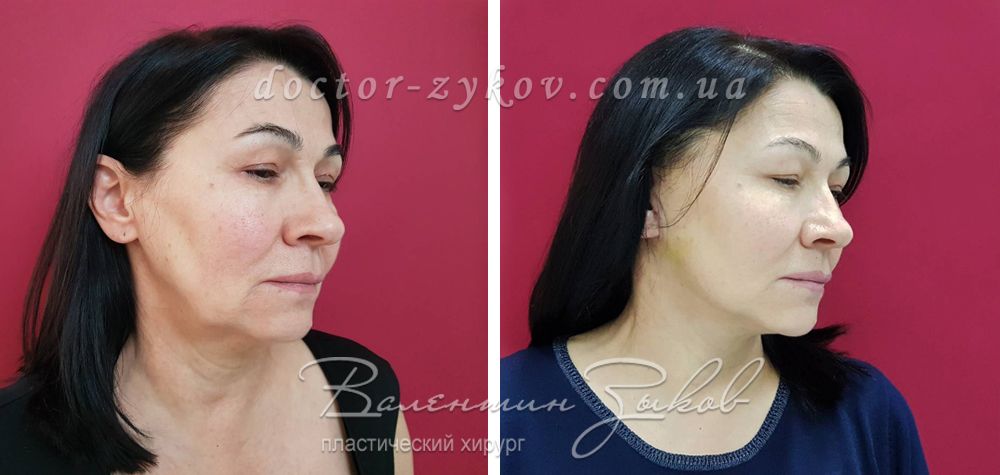
Circular SMAS facelift and neck lift, after 2 weeks. Work by Valentyn Zykov
During a facelift, the internal SMAS layer is necessarily tightened, moving to the maximum position. Above it is the subcutaneous fat layer and skin, which are pulled along with the SMAS layer. The larger this layer, the more skin displacement, and the less skin tightening. Therefore, it is advisable to pull both the SMAS layer and the skin.
If the skin is first excised and then stretched, there is a lot of tension in the scar area, and the patient may get a rough scar. Therefore, simply excising the skin to stretch it is incorrect, as was done in the past. Advanced surgeons now use SMAS layer tightening + thread installation for facelifts.
Can you do a facelift if threads have already been placed?
The myth about the impossibility of such a procedure comes from surgeons who know how to perform surgical facelifts but do not know how to place threads or did not know how in the past. This is an older trend when it was believed that after threads or after Ulthera or ultrasonic SMAS lifting, a facelift was impossible. Now the position of surgeons is changing a lot.
Doing a facelift after threads is possible, but it will be a bit more complicated. More infiltration is needed, and the doctor will have to spend more time on dissection, but this is not a problem. Therefore, you can safely place threads, and there will be no difficulties with surgical lifting in the future.
At what age should you do thread lifting and facelifting?
Those who start placing threads earlier, for example, at 35-40 years old, experience a good stabilizing effect. The beautiful shape of the oval, especially the middle and lower thirds of the face, is better preserved for a long period. Thanks to this prolonged effect, serious surgical interventions can be significantly postponed.

Thread lifting before and after. Work by Valentyn Zykov
When surgeons and cosmetologists first started placing threads about 15 years ago, they did not yet know how pronounced the effect would be and what it would look like over time. But the threads have passed the test of time with “excellent” marks. You should not expect a wow effect like from a facelift, where tissues can be strongly pulled. But the slight effect you will see two months after thread lifting will last for a long time. This is the main advantage of threads over a facelift, where the effect still fades every month.
How do you know it’s “time” to place threads?
When you start noticing changes in your face, it is usually around the age of 40. For some, it is at 35, but this is more of an exception. At 40, 42, or 43 years old, it makes sense to fix what you have. Then the effect you get will last until you are 50 without any serious changes. If you do not do this, the face will continue to sag. But remember that everything is individual, and an effective set of procedures can only be recommended after consulting a plastic surgeon.


